Pattern production and community emergence in the minority game
E. Estevez-Rams, D. Estévez Moya, H. Kantz
2026journalChaos, Solitons & Fractals (vol. 202), pp. 117465
Resumen
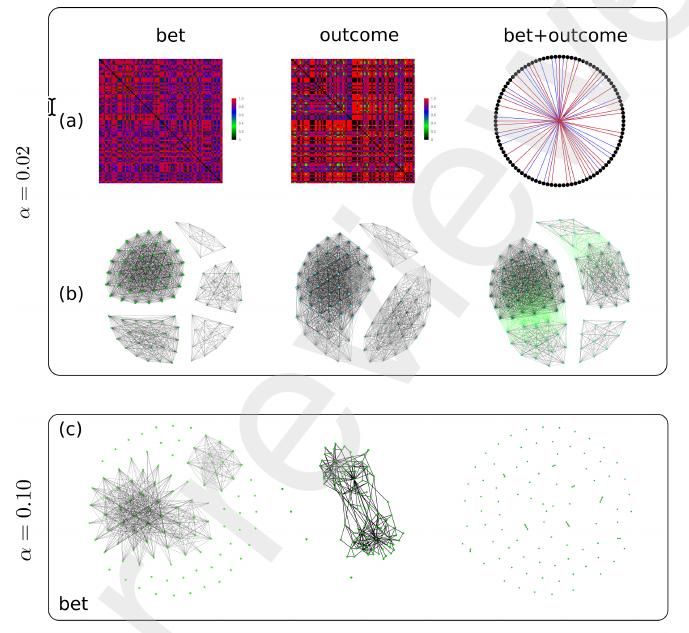
The original minority game is revisited to study pattern generation and the emergence of dynamic communities in a system where collective behaviour does not stem directly from interactions between agents. We introduce a novel approach using entropy density and information distance, specifically a computable measure based on Lempel–Ziv complexity, to identify and analyse these emergent communities. While previous studies have indirectly shown that collective behaviour emerges beyond a critical point, this work directly describes the formation and evolution of agent communities by calculating the distance matrix between players. The analysis reveals that distinct communities can form based on either the agents’ betting policies or their winning outcomes, and the relationship between these community structures is not simple. Our findings show that in the “crowded region” of the game (low values), well-defined, fully connected communities emerge, whereas in the “uncrowded region” (high values), agents behave independently. This methodology of using entropic measures to identify collective classes is generalizable and can be extended to other complex systems, even those lacking direct interactions.